
Knee replacement surgery has helped millions of people regain mobility and live with less pain. Modern implants are designed to last for many years, allowing patients to return to their daily routines with greater comfort and confidence. However, like any medical procedure, a knee replacement may occasionally require further evaluation if problems develop over time. In such situations, consulting a Revision Knee Replacement Specialist becomes essential.
Revision knee replacement is different from a primary knee replacement. It is a highly specialized procedure performed when an existing artificial knee joint no longer functions as expected due to wear, loosening, instability, infection, or other complications. Because these cases are often more complex, they require careful planning and the expertise of an orthopedic surgeon experienced in revision procedures.
What Is Revision Knee Replacement?
Revision knee replacement is a surgical procedure in which part or all of a previously implanted artificial knee joint is removed and replaced with new components.
Unlike the first knee replacement, revision surgery often involves addressing additional challenges, such as:
- Bone loss around the implant
- Damaged soft tissues
- Joint instability
- Scar tissue
- Implant loosening
- Previous infection
Every revision procedure is unique, which is why a detailed evaluation is necessary before recommending surgery.
Why Might a Knee Replacement Need Revision?
Most knee replacements perform well for many years. However, certain factors can affect the long-term performance of the implant.
Some common reasons include:
- Wear of the implant over time
- Loosening of implant components
- Recurrent instability
- Persistent pain
- Fractures around the implant
- Mechanical failure
- Reduced range of motion
- Infection affecting the joint
Not every patient with knee discomfort after replacement surgery requires revision. A specialist first identifies the exact cause before suggesting treatment.
Warning Signs You Should Not Ignore
Patients who have previously undergone knee replacement should seek orthopedic evaluation if they notice persistent or new symptoms.
Possible warning signs include:
- Increasing pain after an initial period of improvement
- Swelling that does not resolve
- Difficulty walking
- A feeling that the knee is unstable
- Clicking or unusual movement within the joint
- Reduced flexibility
- Warmth or redness around the knee
- Sudden changes in walking ability
These symptoms may indicate problems that require medical assessment rather than simple pain management.
How a Revision Specialist Evaluates the Knee
Revision surgery is never planned based solely on symptoms. A comprehensive assessment helps determine whether surgery is truly necessary.
The evaluation usually includes:
- Review of previous surgical history.
- Physical examination.
- Assessment of knee movement and stability.
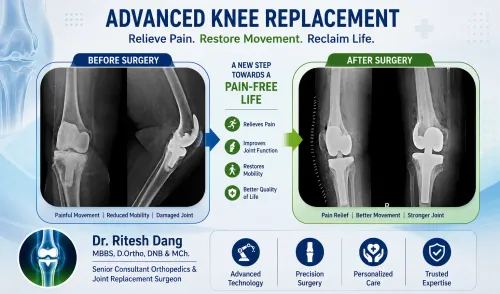
- Digital X-rays.
- CT scan or MRI when required.
- Blood tests if infection is suspected.
- Analysis of implant position and surrounding bone.
This detailed approach allows the surgeon to recommend the safest and most effective treatment plan.
Is Revision Surgery Always Required?
Fortunately, the answer is no.
Some patients experience discomfort because of muscle weakness, inflammation, or minor alignment issues that can be managed without surgery.
Depending on the diagnosis, treatment may include:
- Physiotherapy
- Medication
- Activity modification
- Supportive braces
- Infection management
- Observation with regular follow-up
Revision surgery is recommended only when conservative treatment cannot resolve the underlying problem.
Why Experience Matters in Revision Procedures
Revision knee replacement is technically more demanding than primary knee replacement because the surgeon must work around an existing implant while preserving as much healthy bone as possible.
An experienced revision specialist focuses on:
- Careful preoperative planning
- Selecting appropriate implant systems
- Restoring knee alignment
- Achieving joint stability
- Minimizing complications
- Planning structured rehabilitation
Expertise plays a significant role in helping patients achieve improved movement and long-term joint function.
Recovery After Revision Knee Replacement
Recovery varies depending on the reason for revision and the complexity of the surgery.
Most rehabilitation programs include:
- Gradual weight-bearing under supervision
- Range-of-motion exercises
- Muscle strengthening
- Balance training
- Regular orthopedic reviews
- Personalized physiotherapy
Following rehabilitation instructions consistently helps patients regain confidence and improve functional outcomes.
Specialized Orthopedic Care in South Delhi
Patients in South Delhi who experience persistent pain or difficulty after a previous knee replacement should seek timely orthopedic evaluation rather than assuming these symptoms are a normal part of recovery. Early assessment often identifies problems before they become more complicated.
Anand Ortho Care Centre- Dr. Ritesh Dang provides comprehensive evaluation for patients requiring assessment after knee replacement surgery. Through jointspecialistdelhi.com, individuals can understand possible causes of implant-related problems, explore available treatment options, and receive guidance based on their specific orthopedic condition.
A Revision Knee Replacement Specialist helps patients navigate complex situations with careful diagnosis, individualized treatment planning, and advanced surgical expertise when required. Whether revision surgery is necessary or conservative care is sufficient, early consultation offers the best opportunity to restore mobility, relieve discomfort, and improve long-term knee function.
Keywords