The choice between total and partial knee replacement depends on which compartments are damaged, whether the ligaments remain stable, and whether the deformity can be corrected—not simply on how advanced an X-ray looks. By the end, you will know how surgeons assess eligibility, what robotic and computer-navigated systems actually do, and which questions to ask before choosing treatment.
Key takeaways
- Partial replacement suits arthritis limited to one knee compartment.
- Total replacement resurfaces all three compartments when disease is widespread.
- Ligament function, alignment, and X-ray findings guide operation choice.
- Robotic navigation improves planning and execution, not every patient’s outcome.
What changes inside the knee with total versus partial replacement?
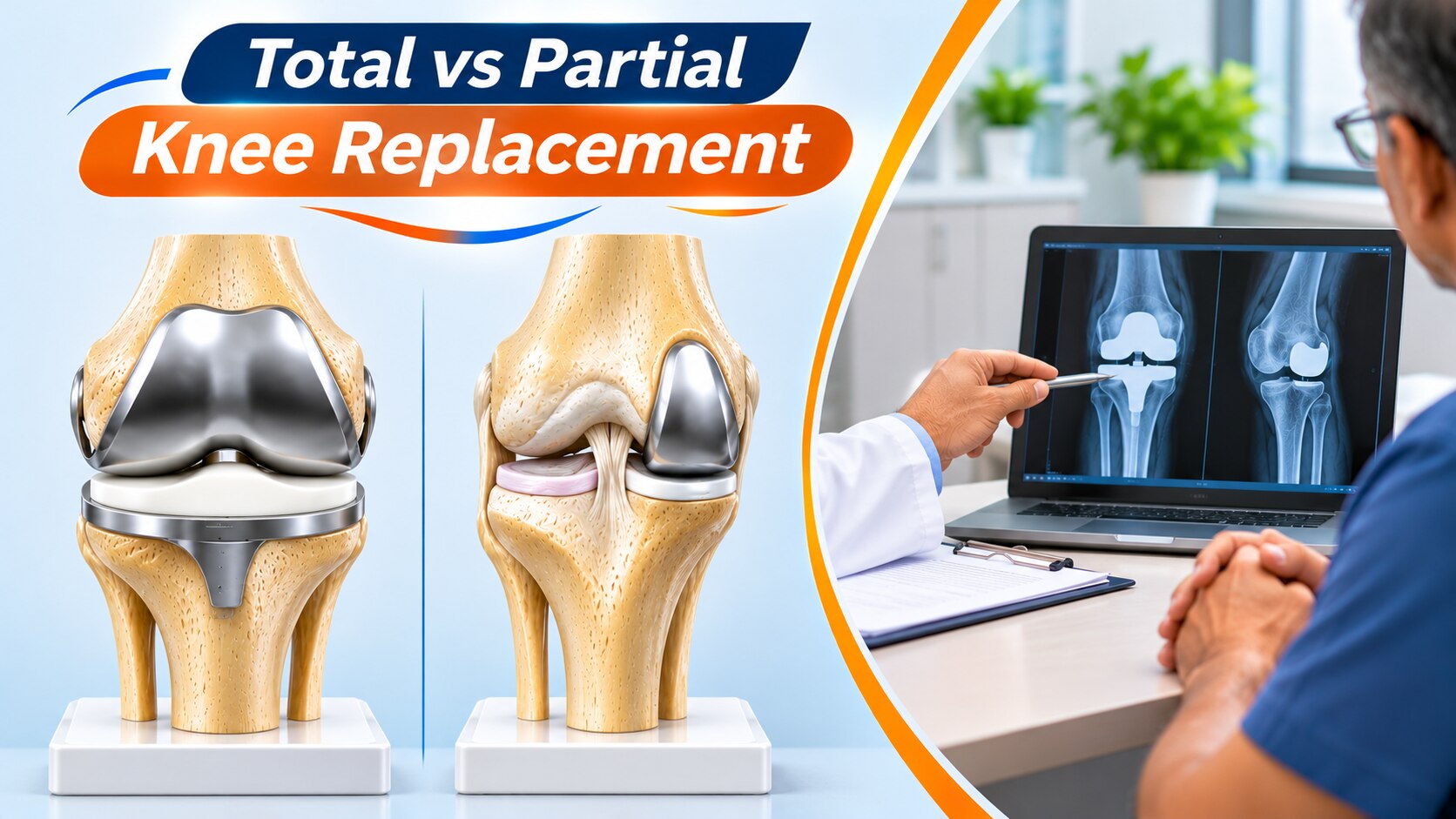
The knee has three compartments: medial, lateral, and patellofemoral. Total Knee Replacement resurfaces the damaged surfaces across all three when disease is widespread; Partial Knee Replacement treats only one—medial, lateral, or patellofemoral—while leaving the other compartments intact.
| Option | Compartments treated | Ligaments preserved | Bone removed and implant design |
|---|---|---|---|
| Total Knee Replacement | Medial and lateral femorotibial surfaces, with the patella resurfaced when indicated | Collateral ligaments remain; the anterior cruciate ligament is usually removed. The posterior cruciate ligament may be retained or removed | More bone is removed from the femur and tibia to fit a femoral component, tibial tray, and polyethylene insert; a patellar button may be added. Designs range from cruciate-retaining to posterior-stabilized or more constrained implants |
| Partial Knee Replacement | Only the arthritic medial, lateral, or patellofemoral compartment | Usually preserves the anterior and posterior cruciate ligaments, along with the ligaments and cartilage in the untreated compartments | Smaller, compartment-specific cuts fit a femoral component and tibial baseplate with a polyethylene bearing. The implant may use a fixed or mobile bearing |
Total replacement therefore replaces the worn joint surfaces and supplies stability through the implant’s geometry when the ACL is sacrificed. Partial replacement relies more heavily on your own ligaments, alignment, menisci, and remaining cartilage; disease spreading into another compartment can undermine its result.
Preserving bone does not automatically make it the safer choice, because partial replacement has a higher revision risk in many comparative studies.
Which knee anatomy determines whether partial replacement is possible?
Partial Knee Replacement is considered only when arthritis is confined to one compartment—medial, lateral, or patellofemoral—and the remaining cartilage and joint surfaces are sufficiently healthy. Your pain must also match that damaged compartment rather than arising throughout the knee.
The anatomy is assessed against these findings:
| Option | Findings that support it | Findings that argue against it |
|---|---|---|
| Partial Knee Replacement | One-compartment cartilage loss; preserved other compartments; stable, functionally adequate ACL and PCL; correctable bow-legged or knock-kneed alignment; useful knee movement | Arthritis in another compartment; major ACL or collateral-ligament instability; fixed deformity; inflammatory arthritis; pain that does not match isolated disease |
| Total Knee Replacement | Damage across two or more compartments; widespread cartilage loss; substantial deformity; ligament insufficiency; severe symptoms and functional limitation despite non-surgical treatment | It is not ruled out by isolated disease, but replacing unaffected compartments adds unnecessary surgery when a partial option is suitable |
A partial procedure becomes less reliable when the knee cannot be brought into a balanced position during examination, or when ligament looseness allows abnormal movement. An intact ACL matters because unicompartmental implants rely on the knee’s natural stability; an absent or non-functioning ACL often directs the decision toward total replacement.
Inflammatory arthritis, such as rheumatoid arthritis, can affect the whole joint even when one area looks worse on an X-ray. Total replacement is also more appropriate when stiffness, deformity, or pain extends beyond the visibly damaged compartment.
How do X-rays and examination confirm the right operation?
An abnormal X-ray alone does not justify replacement: the operation must match your pain and loss of function. Weight-bearing radiographs taken while standing reveal compartment narrowing under load; non-weight-bearing images can make cartilage loss look smaller than it is.
- Standard front and side views show joint-space loss, bone spurs, and deformity in the medial or lateral compartment.
- A patellar, or sunrise, view examines the patellofemoral compartment, which can rule out an isolated partial procedure.
- A standing long-leg alignment film shows whether the leg is bowed or knocked-kneed and whether arthritis appears confined to one compartment.
Your symptoms must match the damaged area. The surgeon asks where pain occurs, which activities provoke it, and whether it remains unacceptable despite appropriate non-surgical treatment. Range of motion records flexion and extension; a fixed flexion contracture or marked stiffness can make Partial Knee Replacement less suitable.
Ligament testing, particularly of the anterior cruciate and collateral ligaments, checks whether the knee is stable enough for a partial implant. Instability often supports Total Knee Replacement instead. A deformity that corrects during stress testing supports partial surgery only when the remaining compartments are healthy and symptoms fit the affected compartment.
MRI is useful when X-rays and examination disagree, or when cartilage, meniscus, ligament, or another pain source needs clarification. It is not routinely needed for clearly visible, load-bearing arthritis, and an MRI finding alone should not decide surgery.
What does advanced, robotic, or computer-navigated surgery actually add?
“Advanced Knee Replacement” is not a standardized operation. It may mean preoperative 3D planning, computer navigation, robotic assistance, patient-specific instruments, or simply a newer implant design. Ask for the exact procedure and the problem it is intended to improve.
| Option | What it adds | What it does not guarantee |
|---|---|---|
| Preoperative planning | Uses X-rays or CT scans to plan implant size, alignment, bone cuts, and component position before surgery | It does not guide the operation in real time |
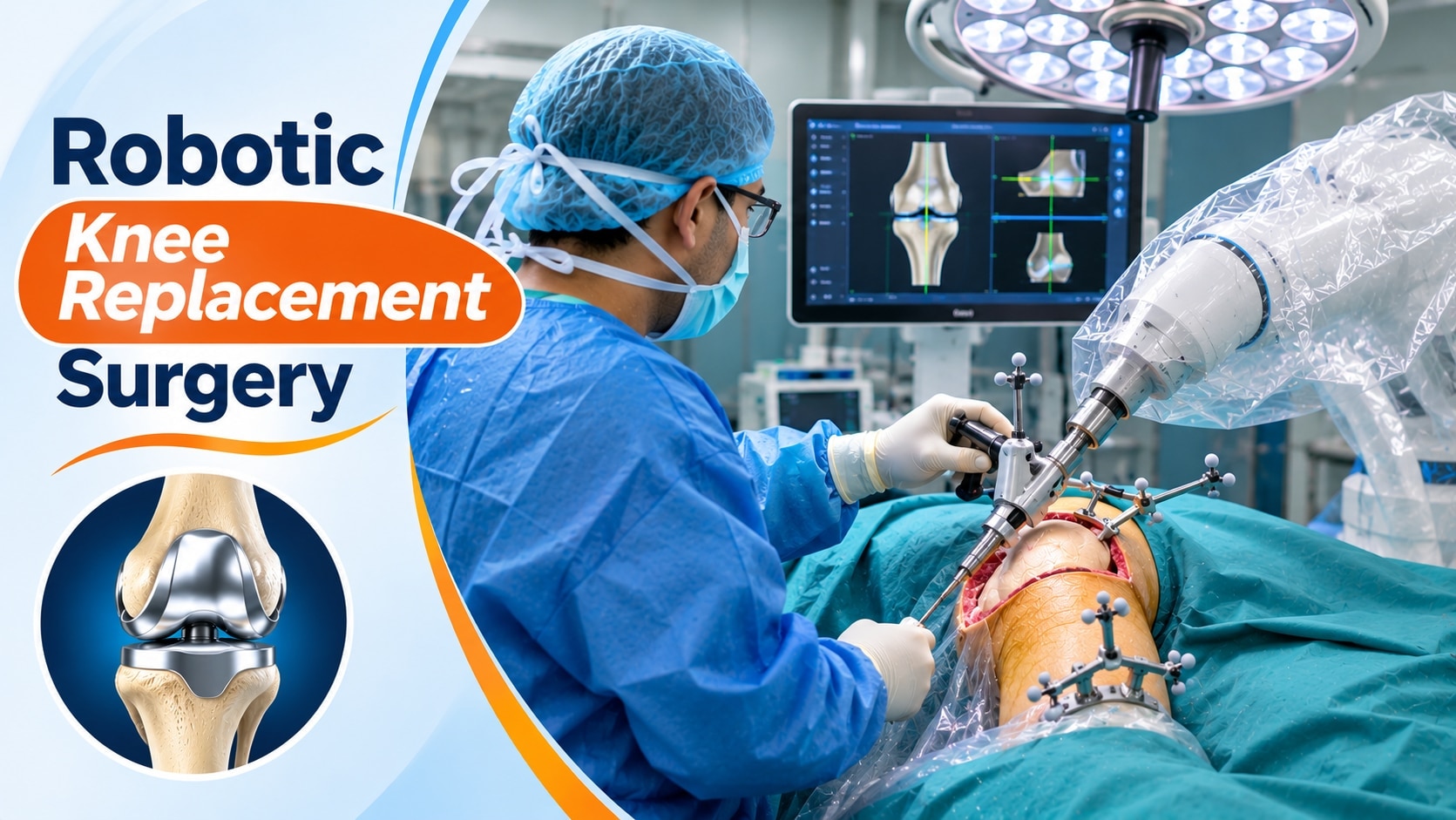
| Computer navigation | Tracks instruments and the knee during surgery, helping the surgeon check alignment, ligament balance, and component position | It does not make the bone cuts independently |
| Robot-assisted surgery | Helps the surgeon execute planned bone cuts within defined boundaries; the surgeon still controls the operation | It does not prove better pain relief, movement, implant survival, or fewer complications |
Ask the surgeon to measure outcomes rather than rely on the word robotic:
- Which alignment or positioning target is the technology expected to improve?
- How do your pain scores, walking ability, range of motion, and function compare with the surgeon’s conventional cases?
- What are the infection, blood-clot, stiffness, nerve injury, and revision rates?
- What is the follow-up period for implant survival, and how are revisions recorded?
- What residual problems remain possible, including kneeling discomfort, clicking, altered skin sensation, or persistent pain?
A robot may improve technical consistency without changing how your knee feels. The surgeon’s experience, correct indication, ligament balancing, rehabilitation, and complication management still matter.
How should you compare knee replacement options and surgeons in Delhi?
Do not choose an operation because a clinic calls it “Advanced Knee Replacement.” Ask the surgeon to name the damaged compartment, proposed implant model, fixation method, and measurable benefit of any navigation or robotic system.
| Decision point | What to compare | What a good answer includes |
|---|---|---|
| Implant choice | Total versus partial replacement, implant design, cemented or cementless fixation | Why that option fits your compartments, ligaments, age, activity and bone quality |
| Technology | Conventional instruments, computer navigation, patient-specific guides or robotic bone cuts | The accuracy target, evidence supporting it, and the surgeon’s comparable conventional results |
| Complications | Infection, blood clots, stiffness, nerve or blood-vessel injury, persistent pain and revision | Their recorded rates, how long patients were followed, and what happens if a complication occurs |
| Rehabilitation | Home exercises, physiotherapy access, walking aids and return-to-work guidance | A staged plan, pain-control instructions and a contact route for setbacks |
| Follow-up | Appointments, wound review, X-rays and monitoring of implant position | Named review intervals and who manages new pain, swelling or reduced movement |
| Revision care | Failure, loosening, wear, instability or infection after either operation | Whether the team performs revision surgery or has a defined referral pathway |
Ask whether pain and function remain unacceptable despite exercise, weight management and medically suitable medicines or injections. A partial replacement can offer quicker early recovery in selected patients, but its revision risk is not automatically lower than total replacement.
For Knee Arthritis treatment Delhi, compare documented outcomes rather than equipment labels. Anand Ortho Care Centre- Dr. Ritesh Dang should be assessed by the same questions: implant-specific reasoning, complication data, rehabilitation access and a clear revision plan. Ask for a written estimate covering surgery, implant, hospital stay, physiotherapy and follow-up.
Related services
Total Knee Replacement by Dr. Ritesh Dang Senior Orthopedic Surgeon | 23+ Years of Experience | Rohini & Model Town, Delhi Are you struggling with constant knee pain,... View service → |
Partial Knee Replacement Surgery Partial Knee Replacement Surgery At Anand Ortho Care Centre – Rohini, Delhi By Dr. Ritesh Dang – Senior Orthopaedic & Joint Replacement Surgeon If you're suffering from localized... View service → |
Frequently asked questions
What is the difference between total and partial knee replacement?
Total Knee Replacement resurfaces the medial, lateral, and patellofemoral compartments. Partial Knee Replacement treats only one damaged compartment and preserves the others.
Which knee anatomy determines whether partial replacement is possible?
Partial replacement depends on disease limited to one compartment, functional ligaments, suitable knee alignment, and healthy remaining cartilage. Damage across compartments usually supports total replacement.
How do X-rays and examination confirm the right knee replacement operation?
Weight-bearing X-rays show joint-space loss and alignment, while examination assesses pain location, range of motion, stability, ligament function, and deformity.
What does robotic or computer-navigated knee replacement add?
These systems help the surgeon plan bone cuts, measure alignment, and balance the knee during surgery. They support surgical precision but do not replace clinical judgment.
How should you compare knee replacement surgeons in Delhi?
Ask about the surgeon’s diagnosis, reasons for recommending total or partial replacement, implant options, surgical technology, rehabilitation plan, complication risks, and follow-up arrangements.
Related services
Computer Navigated Knee Replacement Computer Navigated Knee Replacement Surgery Advanced Precision at Anand Ortho Care Centre – Rohini, Delhi By Dr. View service → |
Robotic Knee Replacement Surgery Robotic Knee Replacement Surgery by Dr. Ritesh Dang Advanced Precision. Faster Recovery. Better Results. View service → |
Keywords