Pain, swelling, stiffness, or a knee that gives way after replacement deserves assessment, but it does not prove that the implant is loose or that another operation is necessary. You will be able to sort emergency symptoms from routine recovery, understand the tests used to identify the failure mechanism, and prepare for a productive specialist consultation.
Key takeaways
- Seek urgent care for fever, drainage, deformity, chest pain, or sudden loss of weight-bearing.
- Pain can result from loosening, infection, instability, fracture, or problems outside the implant.
- Bring operative notes, implant details, X-rays, blood tests, and a timeline of symptoms.
- Choose a revision specialist who explains testing, implant options, risks, and rehabilitation clearly.
Which symptoms require urgent, prompt, or routine assessment?
A hot, rapidly swollen knee, wound drainage, fever or chills, sudden inability to bear weight, new deformity, severe calf swelling or pain, chest pain, or breathlessness requires urgent medical assessment.
| Time frame | Symptoms | What to do |
|---|---|---|
| Urgent | Hot swelling, drainage, fever or chills, sudden inability to bear weight, deformity, severe calf symptoms, chest pain, or breathlessness | Seek emergency assessment for possible infection, fracture, dislocation, deep-vein thrombosis, or pulmonary embolism. |
| Prompt | New or worsening pain after a pain-free interval; progressive weight-bearing or start-up pain after sitting; rest or night pain; recurrent swelling; instability; reduced walking distance; loss of motion; deformity; or clicking with declining function | Contact a revision-focused knee specialist rather than waiting for routine review. |
| Routine | Early soreness, swelling, stiffness, and limited walking that follow the surgeon’s rehabilitation plan and steadily improve | Continue the prescribed exercises, medicines, wound care, and scheduled follow-up. |
Start-up pain after sitting is a reason to investigate Knee Implant Loosening, but symptoms alone cannot confirm loosening. X-rays, examination, and sometimes infection testing are needed.
Contact a specialist promptly for persistent pain, stiffness, recurrent fluid, or declining function even without fever or drainage. Late infection can develop years after surgery and can present without fever. Do not assume a quiet-looking wound rules it out.
A new or worsening problem deserves assessment; watchful waiting can delay treatment of infection, loosening, fracture, or instability.
What can make a replaced knee painful or unstable?
Pain in a replaced knee does not automatically mean a loose implant or justify Revision Knee Replacement. Aseptic loosening is only one possibility; periprosthetic joint infection, polyethylene wear, osteolysis, instability, malalignment, stiffness, periprosthetic fracture, dislocation, extensor-mechanism failure, and tendon problems can produce overlapping symptoms.
Pain referred from the hip or spine can feel like a knee problem.
Clues guide investigation but do not establish a diagnosis:
- Giving way or instability suggests a stability problem, while progressive stiffness suggests restricted motion or scarring.
- Deformity or altered alignment suggests malalignment, bone loss, or a component change.
- Clicking matters more when it occurs with swelling, locking, or declining function.
- New weight-bearing pain, start-up pain, or worsening pain after satisfactory recovery requires assessment, not an automatic revision decision.
A revision-focused surgeon must identify the failure mechanism before recommending surgery. Revision is more complex than primary replacement: removing well-fixed components can cause bone loss, and reconstruction may require ligament balancing, stems, augments, cones, sleeves, or constrained implants.
When the implant is stable and no correctable mechanical or infectious cause is demonstrated, observation, physiotherapy, analgesia, treatment for hip or spine pain, or management of medical risks may be safer. Revision surgery is not a reliable treatment for unexplained pain alone.
How are loosening and late infection investigated?
Loosening and late infection require a structured work-up, not one X-ray. The examination assesses warmth, swelling, tenderness, range of motion, stability, alignment, gait, and wound changes.
Standing anteroposterior and lateral knee radiographs are the starting images. Add skyline, also called Merchant, patellar views to assess the patellofemoral component. Request long-leg alignment films when limb alignment is in question, and compare every current image with earlier films.
| Finding | What it may suggest | Why it cannot settle the diagnosis |
|---|---|---|
| Radiolucent lines | Bone-cement or implant interface change | They can be minor or non-specific |
| Component migration | Progressive loosening | Early loosening may show no migration |
| Alignment change | Malalignment or component movement | Position can appear different because of technique |
An implant can be loose without obvious migration on an initial film. A diagnosis of Knee Implant Loosening depends on symptoms, examination, serial imaging, laboratory results, and exclusion of infection.
For suspected infection, order C-reactive protein (CRP) and erythrocyte sedimentation rate (ESR). If infection remains possible, aspirate the knee for synovial white-cell count, differential, and culture. Normal CRP or ESR does not exclude low-grade infection, so infection must be ruled out before labelling a component aseptically loose.
CT can assess component position and bone loss. Ultrasound, bone scans, and other nuclear-medicine imaging have selective roles when the clinical question remains unresolved. Imaging choice depends on the suspected failure mode; a scan alone does not decide whether Revision Knee Replacement is appropriate.
What should you bring before a revision consultation?
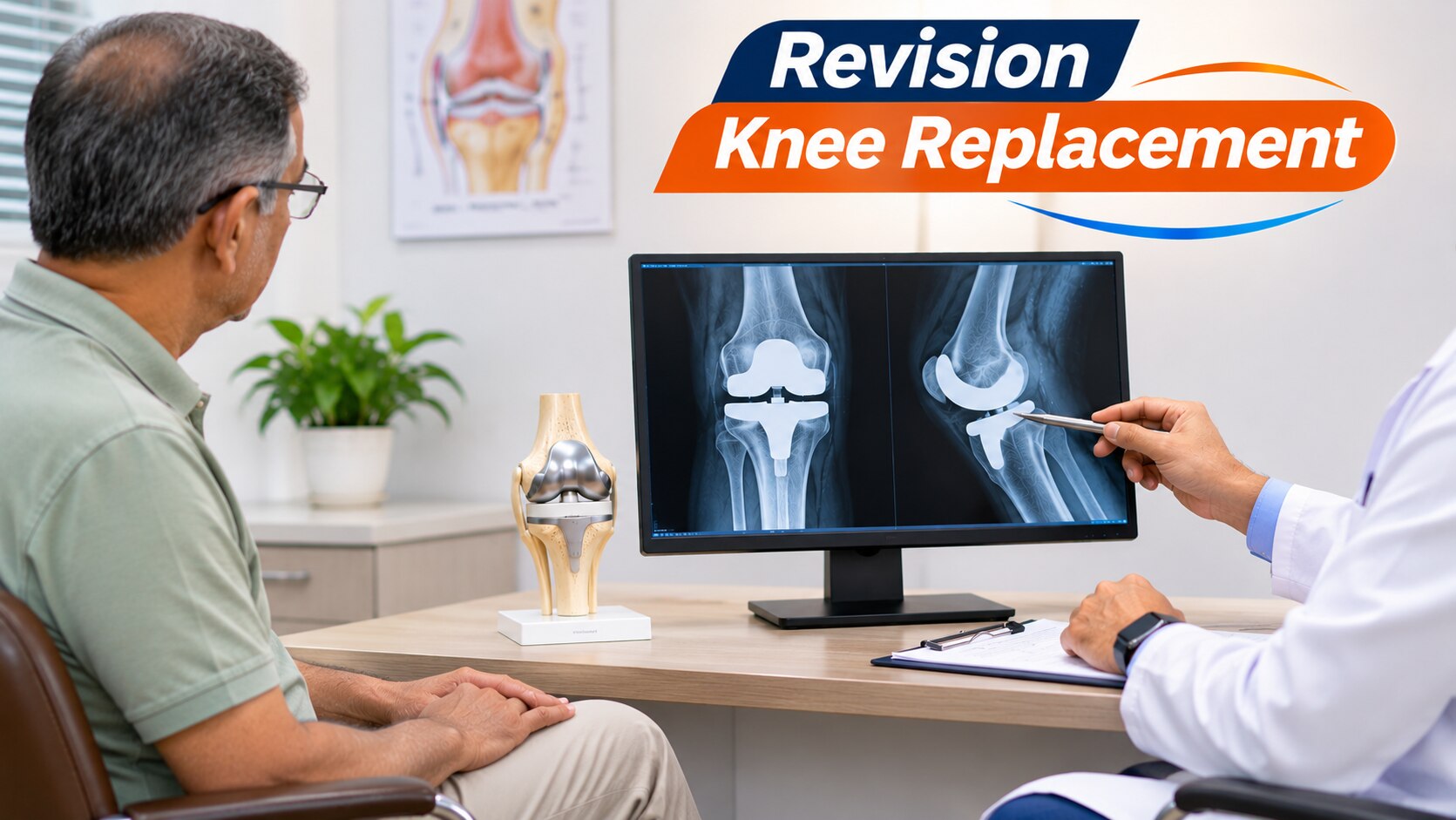
Bring the complete record, not only the latest X-ray. The consultation should establish the failure mechanism, whether infection has been excluded, and whether any correctable problem exists before surgery is discussed.
- Collect the original operative report, discharge summary, implant stickers or registry card, and component names and sizes.
- Bring prior X-rays and scans, including images from before and after the replacement. Serial films help show progression.
- Add infection-treatment records, antibiotic or injection history, your current medication list, and details of diabetes and other medical history.
- Write a dated timeline covering pain, swelling, instability, walking limits, falls, and previous treatments.
Missing implant information can complicate planning because the surgeon must identify the existing component system and compatible revision parts. It does not make assessment impossible; hospitals and implant manufacturers may help retrieve records.
Ask these questions:
- What failure mechanism is documented?
- Has infection been excluded with appropriate testing?
- Do serial films show progression?
- Is bone loss or ligament instability present?
- What nonoperative options remain?
- What benefit and risks would Revision Knee Replacement offer?
A second opinion is reasonable when surgery is proposed for pain alone, infection testing is incomplete, major bone loss or instability is suspected, or alternatives and expected benefit have not been explained. Ask whether observation, physiotherapy, analgesia, treatment of hip or spine pain, or management of medical risks is safer while the implant remains stable.
How should you choose a revision knee specialist in Delhi?
Choose a surgeon who confirms that your appointment is for revision arthroplasty, not routine primary knee replacement. People searching “Revision Knee Replacement Delhi” or the truncated phrase “Revision Knee Surger” should verify the surgeon’s revision focus before booking.
| Appointment type | What it covers | What to verify |
|---|---|---|
| Primary knee consultation | First-time replacement planning | Not a substitute for revision assessment |
| Revision arthroplasty consultation | Failed or painful existing replacement | Failure-mechanism analysis, implant planning, and revision experience |
| General pain review | Nonoperative assessment | Whether hip, spine, tendon, or medical causes are being checked |
The consultation should provide access to standing knee radiographs, earlier films for comparison, aspiration when infection remains possible, implant records, and rehabilitation support. A scan alone cannot establish the need for revision.
Bring the original operative report, implant stickers or registry card, discharge summary, X-rays and scans, antibiotic and injection records, medication list, and a dated symptom timeline. Ask for a documented failure mechanism: loosening, infection, instability, malalignment, wear, stiffness, or another cause.
Anand Ortho Care Centre- Dr. Ritesh Dang is a Delhi option for discussing a problematic knee replacement and reviewing whether symptoms indicate mechanical failure, infection, or another pain source.
Seek urgent care, not a routine consultation, for a hot rapidly swollen knee, drainage, fever or chills, sudden inability to bear weight, new deformity, severe calf pain or swelling, chest pain, or breathlessness. Specialist assessment—not pain alone, one X-ray, or a search result—determines whether revision is appropriate.
Related service
Revision Knee Replacement Surgery Revision Knee Replacement Surgery Expert Care at Anand Ortho Care Centre – Rohini, Delhi By Dr. View service → |
Frequently asked questions
Which symptoms after knee replacement require urgent medical assessment?
Seek urgent assessment for a hot, rapidly swollen knee, wound drainage, fever or chills, sudden inability to bear weight, new deformity, severe calf swelling or pain, chest pain, or breathlessness.
What can cause pain or instability after knee replacement?
Possible causes include implant loosening, infection, instability, fracture, wear of implant components, stiffness, nerve pain, or problems in the hip, spine, or surrounding muscles.
How are knee implant loosening and late infection investigated?
Assessment can include a physical examination, standing and specialised X-rays, comparison with earlier images, blood tests such as ESR and CRP, and joint-fluid analysis when infection is suspected. CT or other scans may be added.
What should you bring to a revision knee replacement consultation?
Bring operative reports, implant cards or manufacturer details, previous X-rays and scans, blood-test results, medication and allergy lists, discharge summaries, and a dated record of symptoms or treatments.
How should you choose a revision knee specialist in Delhi?
Ask about experience with revision knee replacement, the proposed cause of failure, tests needed before surgery, implant choices, infection management, expected rehabilitation, complications, and alternatives to revision surgery.
Keywords