
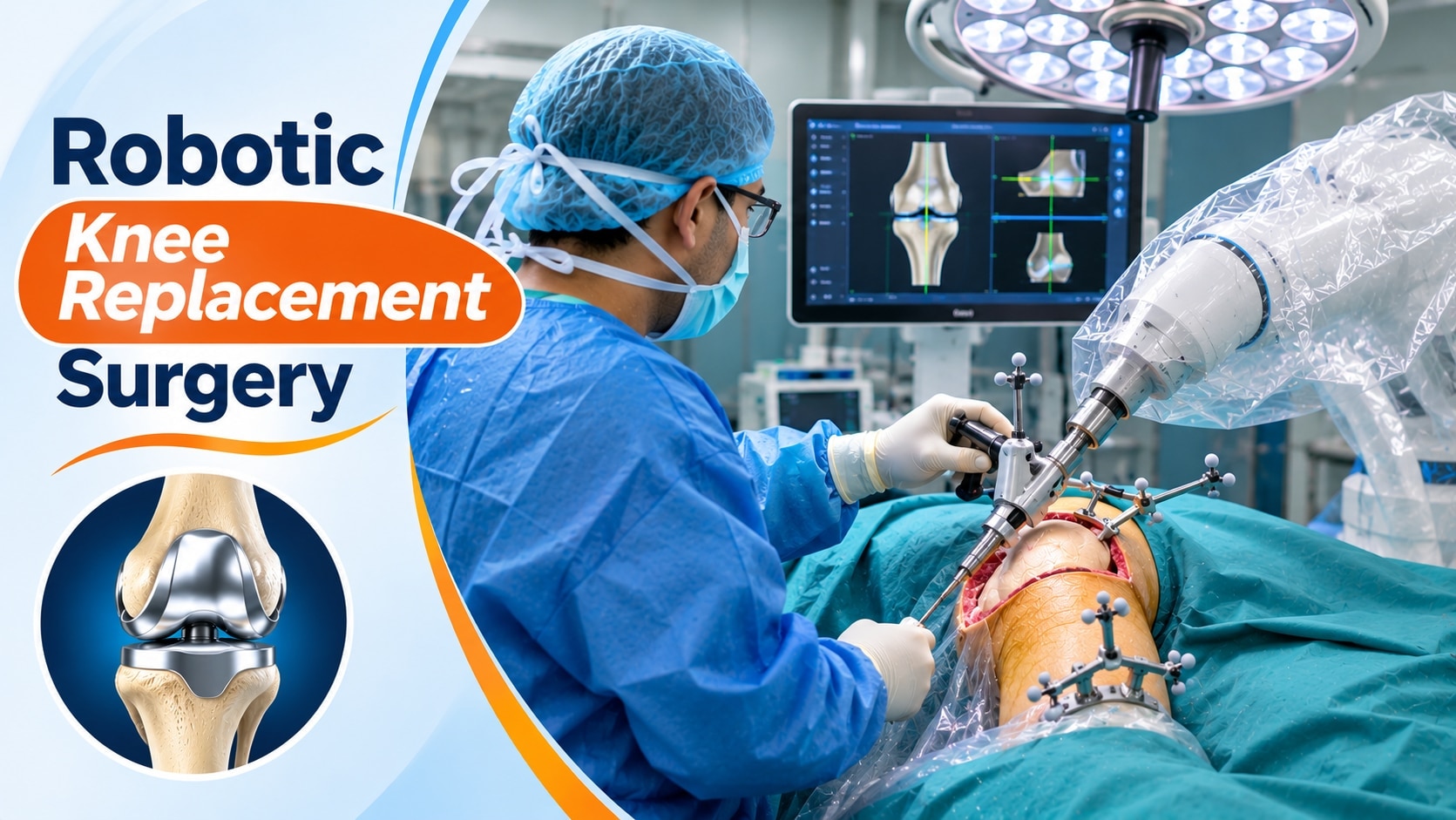
Robotic knee replacement does not mean a machine independently performs the operation. You will learn how the surgeon plans and executes the procedure, how knee implant alignment is checked, what the technology can and cannot improve, and how to evaluate a treatment team in Delhi NCR.
Key takeaways
- The surgeon controls every step; the robot provides planning and instrument guidance.
- Ask how the surgeon checks bone cuts, ligament balance and final implant alignment.
- Compare mechanical, kinematic and restricted kinematic alignment philosophies.
- Choose a surgeon with documented robotic experience and a clear revision plan.
What Robotic Knee Replacement Actually Changes in the Operating Room
The robot assists the surgeon; it does not independently perform a knee replacement. Robotic Knee Replacement uses computer-assisted planning and instrument guidance, while Robotic Knee Surgery generally describes the same surgeon-led approach rather than fully autonomous surgery.
The surgeon remains responsible for:
- Confirming the diagnosis and deciding whether replacement is appropriate
- Selecting the implant and reviewing the computer-generated plan
- Exposing the knee and registering the patient’s anatomy
- Choosing or adjusting the femoral and tibial bone cuts
- Controlling the saw or burr during bone preparation
- Testing trial components and balancing the ligaments
- Checking component position, knee stability, movement and the final result
The system can define planned resection depths, restrict an instrument’s path or show alignment information, but it does not replace surgical judgement. The surgeon can change the plan when the exposed knee, bone quality or ligament tension differs from the scan or software model.
The usual reason for replacement is symptomatic, advanced arthritis or severe joint damage that has not improved enough with activity modification, medicines, injections and physiotherapy. Robotic assistance does not create a new indication for surgery.
A robot also cannot substitute for a careful diagnosis or a discussion of non-surgical alternatives. Ask why replacement is recommended now, what other treatments remain, and how the surgeon will verify alignment and balance during the operation.
How the Robotic Workflow Maps, Prepares and Checks the Knee
The workflow begins with either a preoperative CT scan or an imageless plan built from landmarks identified during surgery. A CT-based system creates a three-dimensional model for planning femoral and tibial cuts; imageless navigation avoids additional ionising radiation but depends on accurate landmark registration.
| Option | Planning basis | Main trade-off |
|---|---|---|
| CT-based | Three-dimensional model from a preoperative CT | More detailed planning, with additional ionising radiation |
| Imageless | Intraoperative anatomical landmarks | No planning CT, but registration accuracy becomes critical |
During Robotic Knee Surgery, the surgeon exposes the knee and registers points such as the femoral head, knee centre, ankle, and joint surfaces. Trackers fixed to the femur and tibia let the system follow bone movement.
The surgeon then reviews planned cuts, prepares the bone, inserts trial femoral and tibial components, and checks ligament tension, motion and medial-lateral gaps before placing the final implants.
Key checks include:
- Confirming each landmark before accepting registration
- Checking that trackers have not moved
- Comparing the digital plan with the exposed bone
- Reviewing bone resection before each cut
- Testing trial components through movement
- Rechecking Knee Implant Alignment and ligament gaps before cementing or seating the final components
A wrong landmark, registration error, tracker movement or unsuitable plan can produce a precisely executed but inappropriate result. That is why the surgeon repeatedly compares software guidance with the actual knee and changes the plan when the anatomy, ligament balance or trial result demands it.
The robot guides execution; it does not issue an unchangeable instruction.
What Knee Implant Alignment Means—and Which Alignment Philosophy Fits
Knee Implant Alignment means more than making an X-ray look straight. It describes the position and orientation of the femoral and tibial components, the hip-knee-ankle limb axis, femoral and tibial rotation, joint-line height, ligament tension, and the balance of medial and lateral gaps.
These choices affect stability, bending, load distribution and walking mechanics. A near-neutral hip-knee-ankle axis does not prove that the knee will feel natural, move well or function normally.
| Alignment philosophy | Main aim | Important consideration |
|---|---|---|
| Mechanical alignment | Place the limb near a neutral hip-knee-ankle axis | Prioritises a standardised axis, but may not reproduce the patient’s native joint |
| Kinematic alignment | Reproduce aspects of the patient’s original joint lines and anatomy | Depends heavily on ligament condition and acceptable bone preservation |
| Functional or restricted kinematic alignment | Preserve selected native features within defined boundaries | Limits extremes when the native anatomy would create instability or excessive wear |
| Hybrid alignment | Combine mechanical and kinematic principles in different parts of the knee | Allows the surgeon to adapt the plan to the individual knee |
No single target fits every patient. Severe deformity, ligament damage, bone loss, previous surgery, retained hardware and implant design can change the safest balance between alignment, stability and bone preservation.
Robotic Knee Replacement can help the surgeon measure these relationships and execute a selected plan with greater consistency, but it does not decide which philosophy suits you. The surgeon still interprets the knee’s anatomy, ligament behaviour and movement before confirming the final component positions.
What Robotic Assistance Can Improve—and What It Cannot Guarantee
Greater technical precision does not guarantee a better long-term knee. Research most consistently finds more reproducible bone cuts and fewer radiographic alignment outliers, but not a large, durable advantage in pain, function, satisfaction or implant survival over a well-performed conventional replacement.
Use this decision sequence when assessing Robotic Knee Replacement:
1. Separate technical accuracy from patient benefit. Robotic Knee Surgery can help assess bone resection and ligament balance before cutting, and may reduce some traditional soft-tissue releases. It does not eliminate manual balancing: a wrong landmark, registration error, tracker movement or unsuitable plan can produce a precisely executed but inappropriate result.
2. Include the technology’s trade-offs. Robotic systems add setup and registration steps, and the operation can take longer during the team’s learning curve. Bone-tracking pins used by some systems add uncommon risks, including pin-site infection and fracture.
3. Judge the complete operation, not the robot. Knee replacement still carries risks of infection, blood clots, bleeding, anaesthetic complications, stiffness, persistent pain, instability, nerve or blood-vessel injury, fracture and later revision.
A robot does not automatically mean a smaller incision, less pain, same-day discharge or faster rehabilitation. Those outcomes depend on the surgical approach, your medical condition, anaesthesia, blood-management protocol and physiotherapy as well as the navigation system. Ask about the specific workflow and the surgeon’s experience, not merely whether the hospital owns a robot.
How to Choose a Robotic Knee Replacement Surgeon in Delhi NCR
Choose a Robotic Knee Replacement Surgeon by the complete treatment pathway, not by a hospital’s robot. Ask why replacement is recommended now, which non-surgical options remain, and what diagnosis makes surgery appropriate.
Use this consultation checklist:
- Does the surgeon use CT-based planning or imageless navigation, and why?
- Which alignment philosophy—mechanical, kinematic, restricted kinematic or hybrid—fits your knee?
- How are anatomical landmarks registered, and how are registration errors detected?
- How are ligament tension and medial-lateral gaps checked before final implantation?
- Which implant design and materials are planned, and who supplies the implant information?
- What are the surgeon’s own complication and revision rates, with the time period and patient group defined?
- What follow-up schedule covers wound review, X-rays, physiotherapy, stiffness, pain and late loosening?
| Planning method | What it uses | What to ask |
|---|---|---|
| CT-based | A CT-derived three-dimensional bone model | How radiation exposure and the CT plan are reviewed |
| Imageless | Intraoperative anatomical landmarks | How inaccurate landmark registration is prevented |
Assess the hospital as carefully as the surgeon: verify accreditation, functioning robotic and imaging equipment, infection-prevention and thrombosis-prevention protocols, physiotherapy availability and emergency access. Ask how pin-site infection or fracture risks are discussed when bone-tracking pins are used.
These criteria apply across Delhi NCR. Anand Ortho Care Centre- Dr. Ritesh Dang is one local team you could discuss robotic assistance and implant alignment with, but diagnosis, workflow, complication data and follow-up matter more than branding.
Related services
Robotic Knee Replacement Surgery Robotic Knee Replacement Surgery by Dr. Ritesh Dang Advanced Precision. Faster Recovery. Better Results. View service → |
Computer Navigated Knee Replacement Computer Navigated Knee Replacement Surgery Advanced Precision at Anand Ortho Care Centre – Rohini, Delhi By Dr. View service → |
Frequently asked questions
Does a robot perform the knee replacement independently?
No. The orthopedic surgeon makes decisions and performs the operation; the robotic system supports planning, bone preparation and instrument guidance.
How does robotic knee replacement check implant alignment?
The system creates a 3D plan, guides bone preparation and provides measurements for alignment, implant position and ligament balance during surgery.
Which knee implant alignment philosophy is best?
Mechanical, kinematic and restricted kinematic alignment each use different targets. Your surgeon should explain the chosen philosophy based on your anatomy, deformity and ligament balance.
How should you choose a robotic knee replacement surgeon in Delhi NCR?
Ask about the surgeon’s experience with the specific robotic platform, alignment strategy, complication management, rehabilitation protocol and revision planning.
Keywords